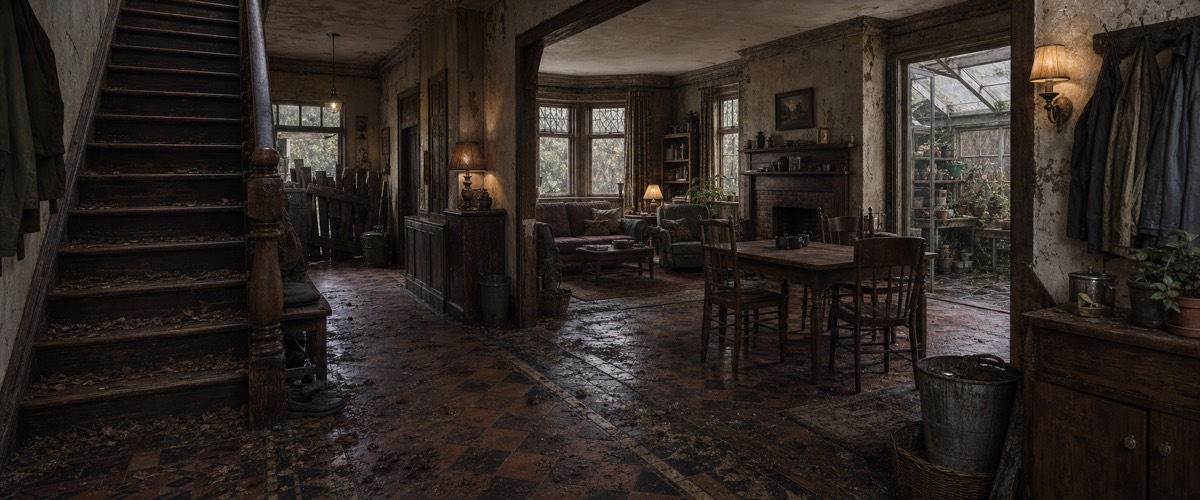
“Non-combatants are to be accounted for by name.”
Anybody alive can be asked. Fenwick has two sorts of survivor in it and you may take in either: the eight to ten named civilians the district is seeded with, and the thirty-odd ordinary survivors already living their own lives out there.
The named ones are put one per building, indoors, scattered — not gathered somewhere convenient. Finding them is play, reaching them is play, and walking them home through the streets at five in the afternoon is very much the game. They start at 25 health and 12 AP, will not scavenge, will not barricade, will not wander, and carry nothing at all. One of them starts injured. Each has a trait that does something: the cook feeds the room on less, the nurse mends the hurt overnight, the hoarder skims a little off every day's food.
The ordinary survivors are the district's own ecology — they scavenge, barricade, heal each other and fight, all without being asked. Taking one in does not gain you a soldier so much as turn a neighbour into somebody you can give an order to.
Finding them
Two ways: walk into the building they are in, or take the Work the radio job, which names somebody you have not yet taken in and the building they are sheltering in.
Recruiting and walking them home
Recruiting costs 2 AP and pays 5 XP. It is refused for anyone below half health — so bring the first-aid kit to them rather than expecting to drag them anywhere.
Escorting is real movement, not a status effect. Every step you take, each follower spends one of their own action points to follow you. When a follower hits zero, they stop where they are and are left behind. A moving line also makes noise — roughly one point of attention for every two people in it, every step.
Posting them
Everyone in your crew can hold something. The named cast hold what their lives fitted them for — the electrician repairs, the nurse patches, the groundsman guards. For everybody else the post comes from what they are: a cop guards, a doctor or a lab tech works as a medic, a firefighter can do either, and an ordinary survivor with an axe can stand at a door.
| They are a… | They can hold |
|---|---|
| Cop | Guard |
| Firefighter | Guard, Repair |
| Doctor | Medic |
| Vitalis lab tech | Medic |
| Civilian | Guard |
Repair is the scarce one. It comes with Construction, and Construction comes only with the firefighter — so the person who puts your barricade back up while you sleep is rare, and worth crossing the district for. A posted repairer mends the weakest side of the building, not the door they happen to be standing at, which is the same rule your own Shore up the walls job follows.
A post is held around the clock. Orders used to resolve only during the assault, on the reasoning that the night is what you posted somebody for. It is not: a hold left to itself through fourteen hours of daylight is a hold with a hole in it, and the daylight is where a lone holder is killed. Their action points are the limit, not the hour — 12 against a six-point role is two acts a fill, so a guard is somebody who intervenes now and then, not a turret.
Orders are given at the post — they have to be standing in the exact cell you want them to hold — and consist of a role and a trigger.
| Role | AP each time it fires | What they do |
|---|---|---|
| Guard | 6 | Put down whatever gets inside here. |
| Repair | 6 | Put the barricade back up as it comes down. |
| Medic | 5 | Patch whoever is hurt at this post. |
| Trigger | Meaning |
|---|---|
| All night | Act every chance you get. |
| Only if they get in | Hold fire until something is actually inside. |
| If the wall drops below 4 | Wait until this side is in real trouble. |
Against a 12-point tank, a role costing 5 or 6 means a posted civilian acts about once an hour. They are a garrison, not a turret. Five of them holding five approaches will change a night; one of them will not save a wall on their own.
Not everyone can hold a post — some of the cast are not able-bodied. And every person you bring home is also a mouth at dinner and a body the wave can smell.
- Anyone living can be asked — the named cast and the ordinary survivors both.
- Recruiting costs 2 AP and is refused below half health — heal them where they stand.
- Escorting spends their AP. At zero they stop and are left behind.
- Orders are given at the wall: they must be standing in the post to take one.