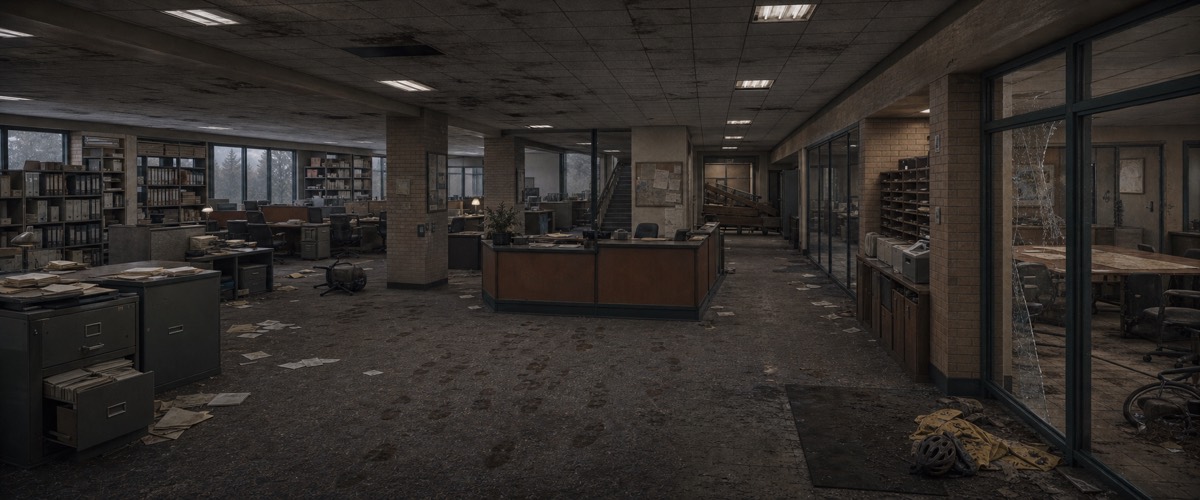
“Prior occupation noted. Not considered relevant to survival outcomes.”
A character is four things: a class, a trait sheet, skills bought with experience, and passives that turn up on their own. There are no levels and no experience bar.
Class
There are 7 classes. A class is a starting kit and a free skill or two — a head start, not an identity. Every survivor can buy every survivor skill, so two people who both picked Cop diverge through what they took and what they did, not through what they are.
Traits — the part that matters
You get 6 points. Positive traits cost two to four of them. Weaknesses refund one to four, and taking them is how you afford the good ones. The sheet has to balance at or under the budget, and three pairs cancel out and cannot be held together: Iron Clock against Bad Sleeper, Quiet Mover against Heavy Footed, Reliable against Shirker.
Nothing forces you to spend the budget. Nothing stops you taking a weakness you think you can live with.
Skills
28 skills exist, split between the living and the dead, and you may only buy for the side you are currently on. They cost experience and nothing else — no cooldown, no training time. The ones worth naming early:
- Construction — the only way past barricade level 4. Someone in the group should have it.
- Free Running — climb into buildings boarded up to 6.
- Vitalis Clearance — the only way to bring a dead player back as a human.
- First Aid — kits heal 15 instead of 10.
The three capstone forks — pistol, shotgun and axe — each offer two options at 200 XP, and taking one permanently closes the other. Choose slowly. Three of the six capstones are listed but not yet implemented.
Passives
Passives are never bought. Each watches a counter and fires the moment you cross its threshold, announced on the wire — earned by doing the thing, not by planning to. Two of the six currently have no effect when earned.
- Class is a starting kit. Every survivor can buy every survivor skill.
- Traits are the real creation step: 6 points, and weaknesses refund.
- Skills cost XP and nothing else. Capstones are one-way doors.
- Passives are never bought — they arrive when you have done a thing enough times.